"Day and Night" Mosaic in Penn Station - New York Cit
Andrew Leicester’s “Ghost Series” in Pennsylvania Station is one of the more intellectually layered public artworks in the city - quiet, easy to miss, but conceptually very deliberate.
Installed in the late 1990s as part of the MTA’s Arts & Design program, the Ghost Series is a set of tile mosaics embedded in the corridors of Penn Station, especially around NJ Transit passageways.
They are not meant to stand out like murals. Instead, they function as subtle, embedded references to the original 1910 Penn Station that once stood above
Leicester’s premise is simple but powerful: The current Penn Station sits on top of a lost masterpiece. So instead of reconstructing the old station, he creates fragments, echoes, and partial images. These act like “ghosts” of the demolished buildings.
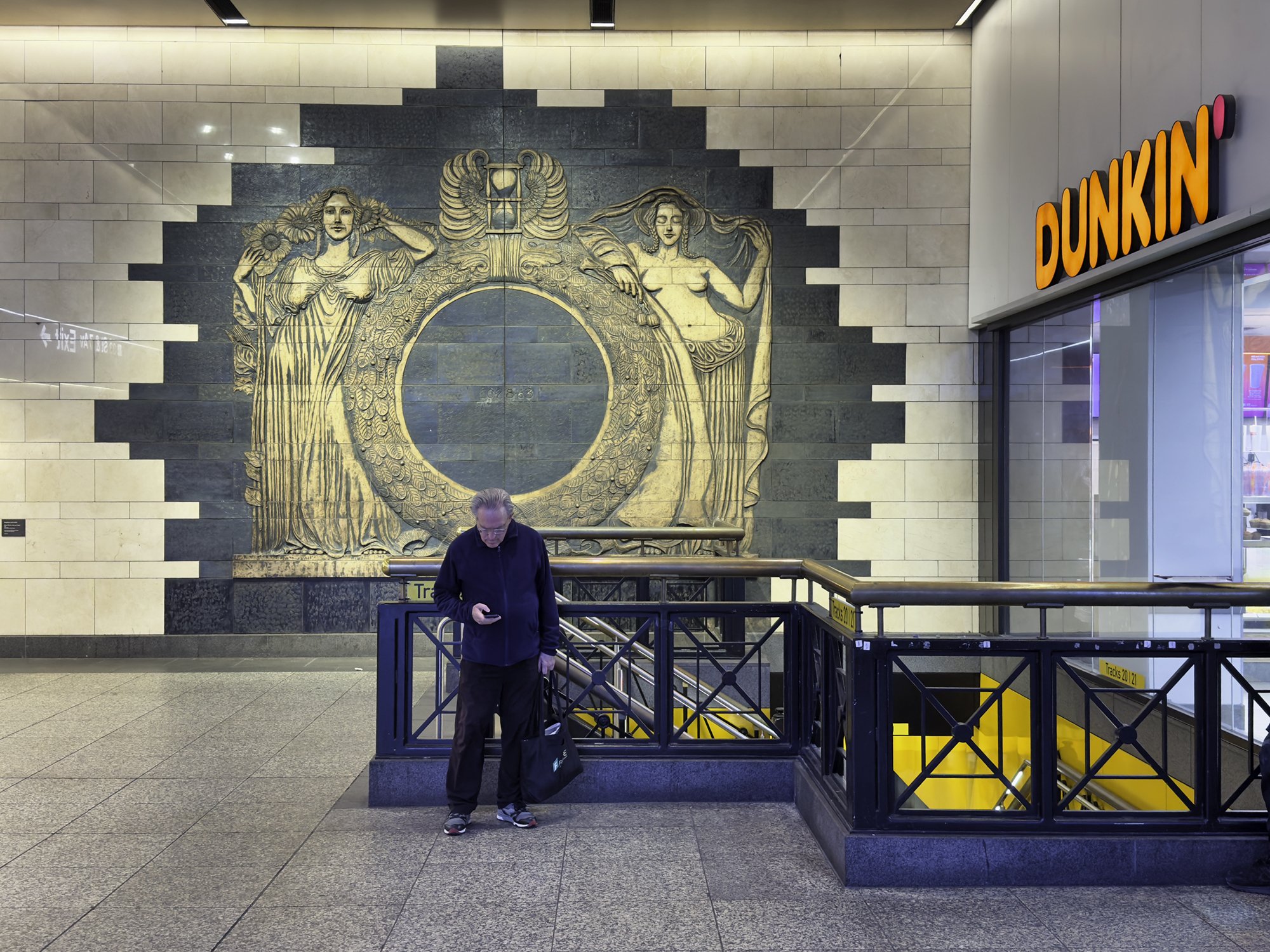
This particular “ghost” is based on original “Day and Night” sculptures by Adolph Alexander Weinman - there were four of them, identical, each placed over one of the four main entrances of the station. Carved in granite or limestone, they were fully three-dimensional and projected out from just under the cornice of the building. Each featured a large central clock flanked by two monumental, classical figures, one representing day and one night. Day, in an open pose and decorated with sunflowers, symbolized the visible, active portion of human life. Night, partially hooded and decorated with a poppy, a classical symbol of sleep, symbolized the hidden, inward side of life.
The monumental, functional clock positioned between them gave a sense of "mechanical" versus cosmic time. The clock was "railroad time," precise, scheduled, modern. The Day and Night sculptures were natural, cosmic time, eternal cycles.
When Penn Station was demolished in 1963, these sculptures, and most of the rest of decorative carvings at Penn Station were destroyed or discarded. One complete one remains in a Park in Kansas City, Missouri, and there is one "Night" statue that was rescued from a dump in the Meadowlands and now is in the outdoor sculpture garden at Brooklyn Museum.
Leicester’s 1990 "ghost" of Day and Night uses tile and mosaic with flattened classical forms and a muted, slightly aged color palette. The two figures are not as finely done as in the originals, while other details, like the wreath surrounding where the clock would be, are more precisely done. This creates a feeling of something halfway between present and memory.
Chiseled somewhat roughly in the center of the large clock-less circle, across two separate tiles are what looks like 102 and 863. This is actually a reminder of the day the demolition of the old Penn Station started: 10/28/63.
I have not found the other pieces of Leicester’s project - they may not be displayed at this time.
But this one is easily visible if you look for it. You'll find it at the very eastern end of the long east-west corridor of station's Lower Level, just before you get to the turnstiles for the 1, 2, and 3 trains.
Tens of thousands of people walk by this work of art every day without noticing. Don't you be one next time you're in Penn Station.