Union Station - Worcester MA
Union Station in Worcester, Massachusetts, is a historic transportation hub located at 2 Washington Square in the heart of downtown. It serves as a terminal for both Amtrak and Massachusetts Bay Transportation Authority (MBTA) commuter rail services, connecting Worcester to Boston and other destinations.
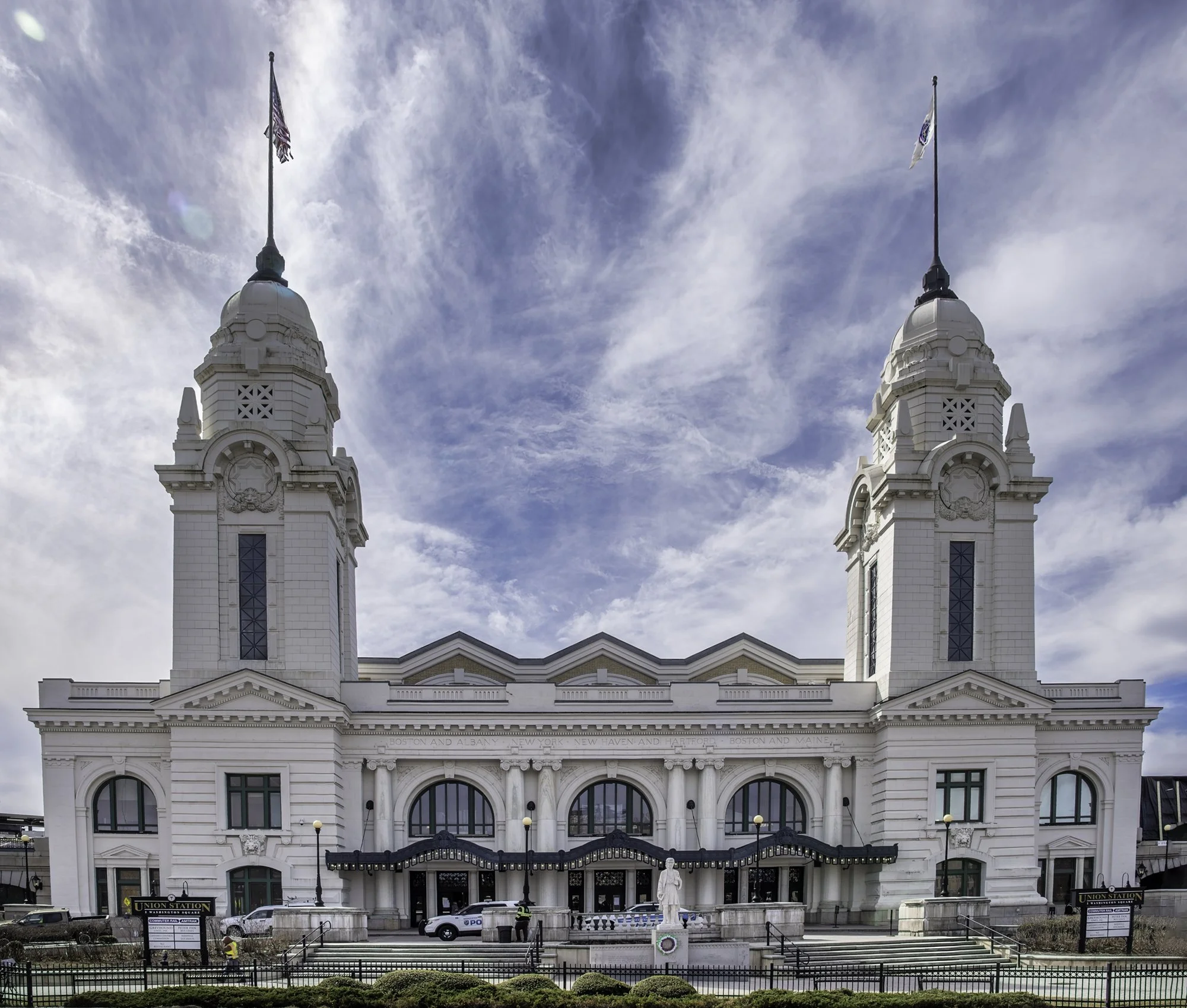
The current Union Station opened on June 4, 1911, replacing an earlier station built in 1875. Designed by the architectural firm Watson & Huckel in a French Renaissance Revival style, the station featured two prominent white marble towers flanking the main entrance. made largely of terra cotta. They turned out to be structurally vulnerable because of constant vibration from heavy rail traffic passing directly beneath and beside the station. By 1926, only about 15 years after the station opened, they were removed for safety reasons. Passenger services declined throughout the 20th century, leading to the station's closure in 1974.
The building fell into disrepair but was added to the National Register of Historic Places in 1980. A comprehensive restoration was completed between 1994 and 2000, culminating in a grand reopening with a gala ball in 1999.
The story of the current towers is fascinating from a preservation-engineering standpoint. During the restoration, architects and sculptors worked from original architectural drawings, surviving photographs, and surviving architectural details to recreate the towers as faithfully as possible. The new towers were built with structural steel frameworks clad with fiberglass-reinforced material rather than original heavy terra cotta. This dramatically reduced weight and improved resistance to vibration and weathering.
Worcester preservationists generally consider the project one of the great architectural restoration successes in Massachusetts. Before restoration, the station was essentially a ruin. The rebuilt towers restored the station’s skyline presence and gave Worcester back one of its signature landmarks.